by Rev. Thom Muller
In Heaven and Hell §213, Emanuel Swedenborg asserts that “In the heavens there is no government except the government of mutual love.” (1)
While this sounds nice and beautiful, and on some deeper level, true, I think most of us will have a reaction like “well, easier said than done”… We all know how complex the human condition is so this almost abstract, romanticized ideal may seem kind of silly. And Swedenborg acknowledges this complexity. While asserting that in the highest states of heaven there is absolutely no compulsion, because by their very nature, spirits there are ruled by freely chosen love for each other, making this work in our day-to-day life often requires inner work. While we CAN connect to that heavenly state of selfless and freely chosen goodness, he acknowledges that, in our present human condition, dominated by such ideals as competition, profit, and self-gratification, cultivating this state takes self awareness and intentionality and a choice to consciously live by certain principles. One of many tools for this that I’ve found helpful are Swedenborg’s “Rules of Life”.
Now you may ask, why would someone who believes there is no government in heaven come up with rules? Well first of all, these were rules for himself. Not for others. Secondly, he didn’t. What we now know as the “Rules” originated in an eulogy delivered at Swedenborg’s memorial service by Samuel Sandels (1724–1784), a colleague of his from the Board of Mines and from the Royal Academy of Sciences. In 1784, just twelve years after Swedenborg’s death, Robert Hindmarsh (1759–1835) published an English translation of the eulogy. These are principles that were associated with Swedenborg, but not formulated by him. While Sandels initially identifies 7 principles, Swedenborgians condensed them into the four which are commonly cited:
1. To often read and meditate on the Word of God
2. To submit everything to the will of divine providence
3. To behave well and to keep my conscience clear
4. To do my work faithfully, and to make myself useful to others in everything I do
I remember, the first time I seriously considered the Rules of Life, I instantly thought of the “four paths of yoga”. “Yoga” comes from the Sanskrit verb “yuj,” to yoke or unite. The goal of yoga is to unite oneself with God; the practice of yoga is the path we take to accomplish this.
1. Karma Yoga – the yoga of action and selfless service
2. Bhakti Yoga – the yoga of devotion
3. Rāja Yoga – the yoga of meditation
4. Jñāna Yoga – the yoga of will and intellect
Sometimes conceptualized as 7 Paths or Yogas, adding Tantra Yoga (ritual devotion, specific practices), Mantra Yoga (sound and repetition), Hatha Yoga (physical effort). In a very real way, both sets of principles encapsulate the same basic principles of living, and there are many levels on which this of a holistic kind of approach to spiritual living can be extremely helpful in maintaining a healthy philosophy of engaged spirituality.
This approach invites us not to get carried away by only one element, like obsessing about doctrinal concepts, or being diligent about rituals and ideas without putting them into practice in living a loving life and treating others well. At the same time, it also reminds me that we all have a different makeup, and different loves attached to each of these principles. Some of us are really drawn to the theological and the philosophical. Others are really drawn to practical experience. That’s ok, we can embrace our RULING LOVES and channel and cultivate them. It’s fine that we’re all different and have different emphases, in fact it’s a good thing!
Something worth noting is that the 4 Rules have a dual focus. In a way that echoes the Ten Commandments. One is devotional, the other practical. They are all quite universal. Regardless of one’s specific religion or spiritual path, if you are spiritually inclined and interested in ethical living, you’ll likely resonate with them. They are very simple, and yet quite profound.
Swedenborg writes in Heaven and Hell §528
“Some people believe it is hard to lead the heaven-bound life that is called “spiritual” because they have heard that we need to renounce the world and give up the desires attributed to the body and the flesh and “live spiritually.” All they understand by this is spurning worldly interests, especially concerns for money and prestige, going around in constant devout meditation about God, salvation, and eternal life, devoting their lives to prayer, and reading the Word and religious literature. […]
No, if we would accept heaven’s life, we need by all means to live in the world and to participate in its duties and affairs. In this way, we accept a spiritual life by means of our moral and civic life; and there is no other way a spiritual life can be formed within us, no other way our spirits can be prepared for heaven.” (2)
We neither have to grasp or accept particular doctrines, join the “one correct religion”, nor do we need to adhere to some super specific code of practice or ritual. If we acknowledge something divine, something transcendent, and live lovingly, we are part of God’s new church, which is universal. Our diversity and variety of thought, paths, traditions, and even beliefs are actually an asset because the divine speaks to us and expresses itself in and through us in as many ways as there are people.
But there is one uniting factor: Something that all members of this “New Church” have in common: Ethical living. This does not mean that they all agree on what ethical living looks like, neither does it mean that they have somehow “figured out” how to optimally ethical at any given moment. We are all flawed. But this new spiritual state, this new “church” only takes hold if we PRACTICE, to the best of our own understanding and ability, a life which honors others, which strives to be more altruistic and less self-centered. To truly see the face of God in others and all of creation, and to act accordingly.
Specifics of beliefs or spiritual or religious practices are awesome and beautiful, as I mentioned, partly because they are so diverse. But they are useless, spiritually speaking, if they don’t move us to actively love others. The most concrete way we encounter God is not in books or rituals, nor is it in sets of rules, but in loving interaction with God’s manifestation and incarnation, our fellow beings.
(1) Swedenborg, Emanuel. Heaven and Hell. Translated by George F. Dole. West Chester: Swedenborg Foundation, 2000.
(2) Ibid.
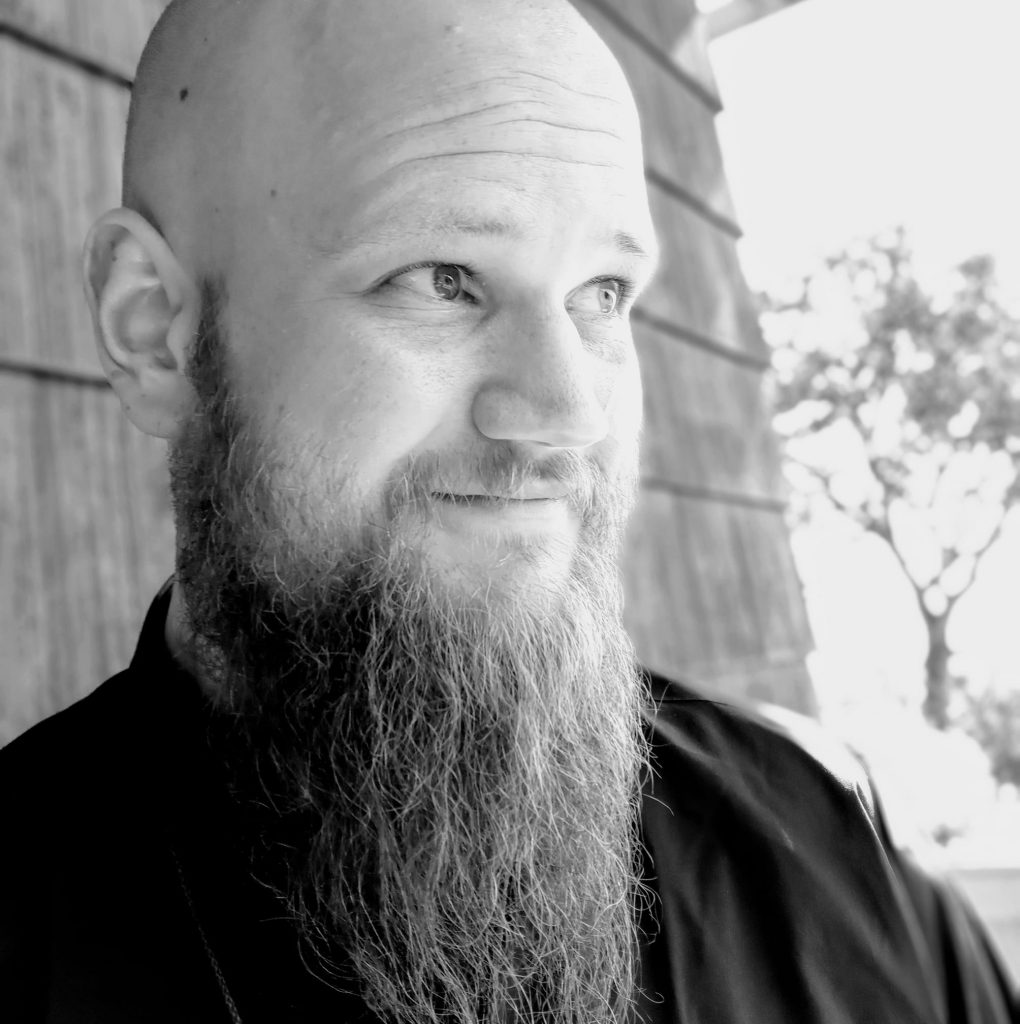
Rev. Thom Muller is pastor at the Swedenborgian Society of the East Bay at Hillside, an Urban Sanctuary, in El Cerrito, CA, as well as senior editor of Our Daily Bread. His passions include the intersection of spirituality and psychology, interfaith theology, and the Western esoteric tradition. A native of Germany, Rev. Muller was ordained into the ministry of the Swedenborgian Church of North America in 2016, upon receiving his theological education at Bryn Athyn College of the New Church and the Center for Swedenborgian Studies and Pacific School of Religion at the Graduate Theological Union in Berkeley.
CategoriesUncategorizedEdit“Thanks for Nothing” -Rev. Thom Muller