In recent years and months, there has been a renewed interest in the so-called “UFO Phenomenon,” partly due to a recent series of reclassifications of government material which deals with unidentified aerial phenomena. Now, of course, there is no explicit tie here between this phenomenon itself and theories or beliefs about extraterrestrial life. All that seems to be confirmed by this is there are objects in the sky sometimes that we cannot identify.
Something I often hear mentioned in this broader conversation is the Drake Equation, formulated in 1961 by astronomer Frank Drake, whose basic argument is that we can, to a certain degree, assess the likelihood of sentient extraterrestrial life by means of statistical probability. The Drake Equation provides a fairly simple formula which specifically addresses the likely “number of civilizations in our galaxy with which radio communication might be possible.” It is important to note that this quite high standard excludes sentient life forms which have not developed a relatively technologically advanced society. If a life form has not developed the means to communicate via radio waves, it does not count. The factors the equation takes into consideration are the fraction of those stars with planetary systems, the number of planets, per solar system, with an environment suitable for life, the fraction of suitable planets on which life actually appears, the fraction of life-bearing planets where intelligent life emerges, the fraction of intelligent civilizations that develop technology releasing detectable signals, and the length of time such civilizations release signals into space. Results have varied greatly considering the advancing and somewhat divisive understanding of astrological definitions. Drake himself concluded that there were around 10.000 such civilizations.
In 1758, Emanuel Swedenborg, had made a similar argument in his work Earths in the Universe or Other Planets:
“I have talked with spirits about the fact that if people consider how incredibly vast the starry heaven is and how incalculably huge the number of stars in it is – and each star is a sun in its own realm, has its own solar system, and is much like our sun. […] Anyone who ponders this in the right way will conclude that all this immensity must be a means of achieving the ultimate purpose of creation, which is a heavenly kingdom in which the Divine can dwell with angels and with people.” -Other Planets §4 (1)
Regardless of where we may be in terms of believing in literal extraterrestrial contact as a cosmological reality, there is something about this theme about a world beyond our own, an intelligence that is not earthly, a society that is untouched by the realities of earth-life. It makes us ask important questions about ourselves, our relationship to each other, to our planet, to human society, and to a reality that transcends earthly confines. Swedenborg asked those questions and he claimed to have received some answers. In his work “Other Planets”, he shares his experiences of having visions of the spirits of many different planets, and insists that there are countless places in the universe which are home to countless civilizations of sentient humanoid beings.
I’m personally inclined not to believe that these beautiful and, I believe, authentic visions are the result of “literal” interactions between Swedenborg and spirits from, say Mars (and he does claim to speak to Martians, among others.) Neither am I inclined to believe that he “literally” talked to Socrates and Plato and Luther in the spiritual world. I am, however, very much inclined that he did, in fact experience the things he claims to have experienced, and that they are deeply relevant to our grasp of universal spiritual realities.
There is another approach which reconciles the metaphysics of Swedenborg’s visions with modern scientific insights, and this ties Swedenborg, the UFO Phenomenon, and many other phenomena together. When we look at the modern study of the UFO Phenomenon, there are basically three main approaches, or theories: The extraterrestrial hypothesis, the psycho-social hypothesis, and the interdimensional hypothesis, the latter of which posits that the things people are seeing are in fact real, but rather than coming from another planet, they are evidence of an intersection between different planes of being, consciousness or reality.
This theory makes some sense to me, although I’m personally not discounting any of the others, I can see arguments for either. The notion that there are a multiplicity of realms or planes of being, existing parallel to each other is essential to Swedenborgian cosmology. In fact, based on this cosmology, we exist simultaneously on several planes, and our spiritual self is in contact with many other spiritual beings on a plane that we’re not always, some of us never, aware of. Swedenborg is very clear that the more subtle spiritual planes we inhabit are fundamentally more real than the natural, temporal. So the notion of there being realms that are outside of our mundane awareness. The idea that, at times, in certain circumstances, be they intentional or unintentional, we perceive glimpses of those different planes, isn’t all that outlandish. In fact, Swedenborg himself implies in different places in Other Planets that folks there exist on a plane that would make it impossible for the average earthling to communicate with them.
I like to entertain a perspective which doesn’t conflict with either of these theories. And that’s the concept of the inner meaning of the Writings. I personally believe that everything in Swedenborg’s published theological works is in fact deeply relevant to our universal spiritual being. This relevance is independent from any notion of literal or metaphysical validity of these or other claims. To me, it’s always been “obvious” that just in the same way that Swedenborg talks about ancient sacred texts having an inner meaning, which relates to our inner self, so do his writings.
I believe that he himself is quite clear about this. Time and time again he insists that the things he is seeing in the spiritual world, and everything that is in the spiritual world, are spacio-temporal representations of spiritual realities. The spiritual world is a world of correspondences, of sacred symbology. Time corresponds to spiritual states, so do colors, shapes demeanors and personalities. The issue I perceive is that Swedenborgians have tended to apply a “New Church” approach to the Bible, but an “Old Church” concept to the Writings.
Here’s just a few statements to consider:
Without mental images formed from finite things, and especially images formed from things that exist within space and time, man cannot begin to comprehend Divine things, let alone the Infinite. -Secrets of Heaven §3938
There is no space and time [in the spiritual world], but state instead; and in the other life states correspond to spaces and times in nature -Secrets of Heaven §2625 (2)
The spiritual world does not possess material space and time corresponding to it. But there appear to be space and time there, the appearances answering to the differences of state affecting the minds of spirits and angels there. -True Christianity §29 (3)
When we know how to raise our minds above images of thought derived from space and time, we pass from darkness into light and taste things spiritual and divine. -Divine Love and Wisdom §69 (4)
For some reason, many of us Swedenborgians have been hesitant to apply this to the Writings, even though, as I pointed out, it really seems that that’s exactly what their author wanted us to do. The whole point of the New Church, the New Age of spiritual enlightenment is that we stop obsessing about the external, and begin becoming more and more open to the internal. The external self is occupied by external, time and space based questions. “Where will ‘I’ be after I die? And what will it look and feel like?”, “Are there people on Mars?”, “Was Jesus literally born from a virgin and did he literally rise from the dead?” All of these are valid and important questions, but I would argue that they are all natural or external questions, based on time and space and thus on the lower or “proprietary” realm of reality. From a spiritual perspective, they are no more relevant than questions about where I will go tomorrow, what I will have for dinner, and so on.
The true spiritual transformation and regeneration occurs when we internalize these concepts as relating intimately to our spiritual being. What difference does it make whether Jesus literally rise from the dead 2000 years ago? It makes a difference when I realize that the story of Jesus’s resurrection corresponds DIRECTLY so my own regeneration. I can encounter the state of the risen Christ as a spiritual reality that is tangible and happening on a more subtle realm, intimately within myself. The historicity of the resurrection is still a valid question, I’m not dismissing it. The inner reality of the spiritual state that’s being expressed applies regardless of the much less important external reality. These are universal spiritual dynamics that are happening within.
It is, however, also important to acknowledge that the inner meaning does not negate the outer meaning. It doesn’t mean that they are “simply allegories” and we can just throw any literal, external information out the window. Swedenborg, for one, believed that certain narratives in the Bible are in fact literally true, and he would include the literal resurrection in it. Swedenborg also most definitely believed he was literally talking to spirits from Mars. But he would acknowledge that the inner sense does not negate the outer sense. To to him, the notion that, in addition to being, as he said, images and scenes that correspond to our spiritual psyche, the notion that these things he’s seeing are also representations of metaphysical realities, isn’t all that outlandish.
However you may interpret what then follows, the point that I feel he keeps hammering into us is this: There is an inner reality which supports and animates and sustains everything there is. A spiritual reality which is filled with meaning and purpose, and a final goal: the union of the created universe with its creator.
(1)Swedenborg, Emanuel. Other Planets. United States, West Chester: Swedenborg Foundation, 2018.
(2) Swedenborg, Emanuel. Arcana Coelestia. London: Swedenborg Society, 1990.
(3) Swedenborg, Emanuel. True Christianity. Translated by Jonathan S. Rose. West Chester: Swedenborg Foundation, 2010.
(4) Swedenborg, Emanuel. Divine Love and Wisdom. Translated by George F. Dole. West Chester: Swedenborg Foundation, 2010.
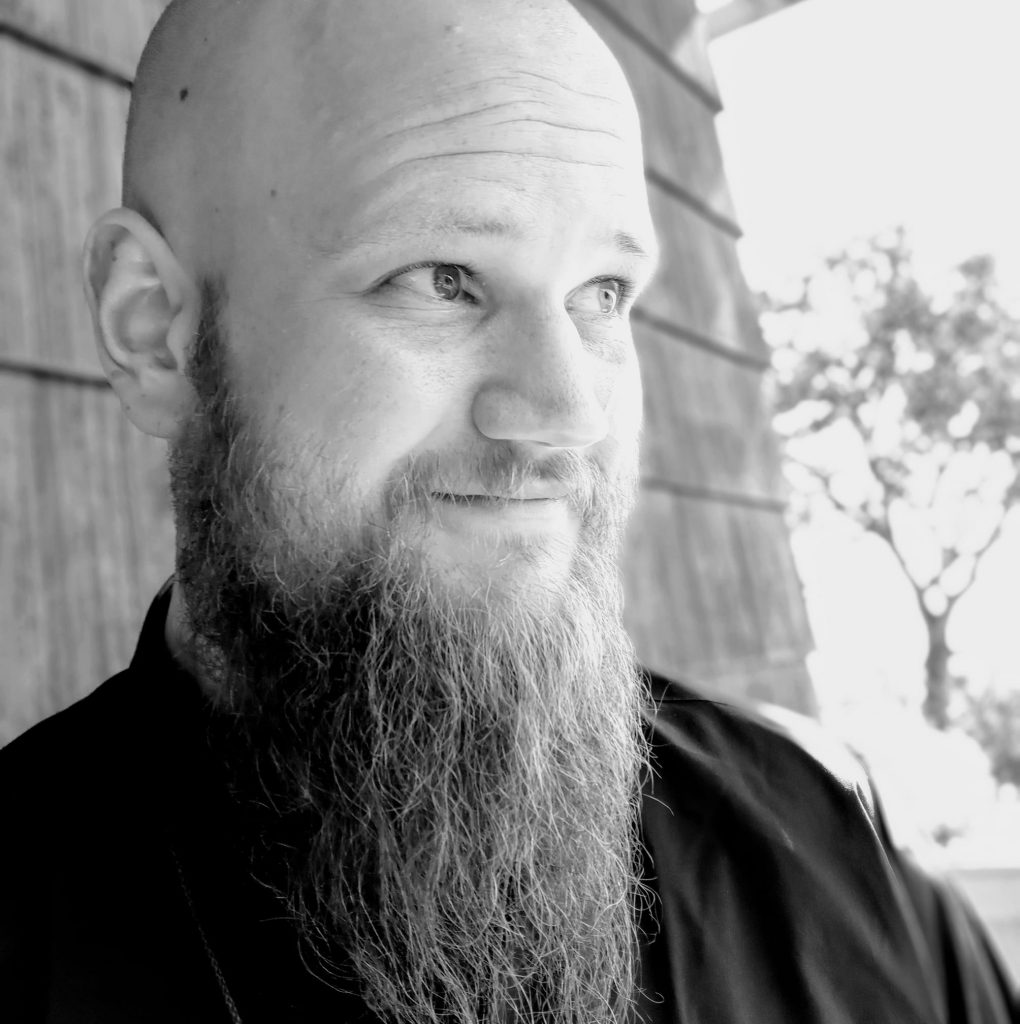
Rev. Thom Muller is pastor at the Swedenborgian Society of the East Bay at Hillside, an Urban Sanctuary, in El Cerrito, CA, as well as senior editor of Our Daily Bread. His passions include the intersection of spirituality and psychology, interfaith theology, and the Western esoteric tradition. A native of Germany, Rev. Muller was ordained into the ministry of the Swedenborgian Church of North America in 2016, upon receiving his theological education at Bryn Athyn College of the New Church and the Center for Swedenborgian Studies and Pacific School of Religion at the Graduate Theological Union in Berkeley.