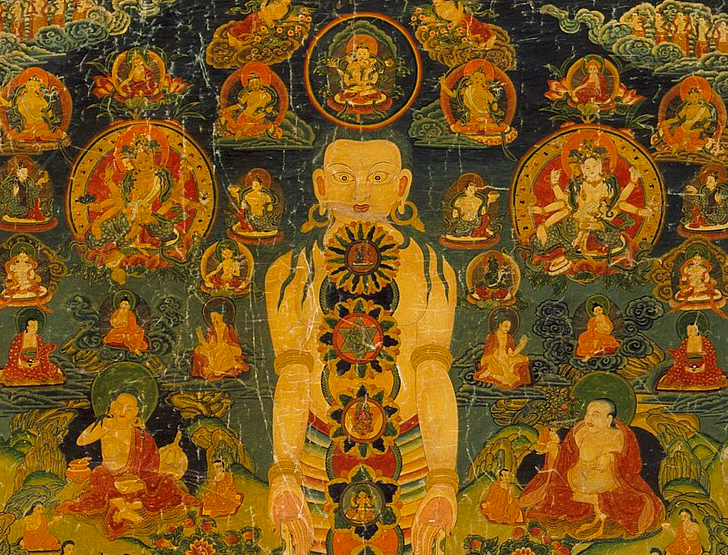
“It is a general rule that nothing can exist and subsist from itself, but from something else, that is, through something else, and that nothing can be kept in form except from, that is, through it, as is evident from each and everything in nature. That on the outside the human body is kept in form by the atmospheres, is known; and unless it were also kept in form within by some acting or living force, it would fall to pieces in a moment; for everything unconnected with what is prior to itself, and through things prior with the First, instantly perishes. The Grand Human, or influx therefrom, is that prior by which we, and all things within us, are connected with the First, that is, with the Lord.”
-Emanuel Swedenborg, Heaven and Hell §3627 (1)
Many traditions have vilified the body as something less-than, and the object of spirituality as subduing the body. Swedenborg believed that the human body was sacred, and in fact, that the human form corresponds directly to not only heaven but divinity itself. He reports beautiful visions of Heaven in shape of human body. The first manifestation of a primal human form, connector to divine influx, and on the highest level, the divine itself. (see Secrets of Heaven §3637)
The concept isn’t completely unique to Swedenborg, but actually exists in the Western esoteric Tradition in several different forms. The concept of a Primal Human spiritual form can be seen in different forms of Hermeticism, Kabbalah, Gnosticism, and so on. The great Jewish theologian and mystic Philo of Alexandria, a contemporary of Jesus, taught about a “ Great Human” who is both a primal spiritual blueprint of the physical human being, created in the image of God, a first emanation, and also a collective human spiritual state. In Christocentric esoteric traditions such as Gnosticism, Rosicrucianism and Christian Caballah, this primal human is often associated with Christ as a primal cosmic reality.
Now you might say, this is an anthropocentric or human-centric concept. And to that is say, yes, it is, by its very definition. The human physical body corresponds to the human spiritual body. But we really have to remember that this is not a concept based in fixed time and space. One might hear this concept and conclude that everything in physical reality goes back to the human form, or that the spiritual world is in a set anthropomorphic boundary. Or that only the human body corresponds to a spiritual body.
This, I believe, would be a misreading. Just like the human physical body corresponds to the universal spiritual human body, so does a physical plant, or animal or even a rock, correspond to a spiritual plant or animal or rock. The physical sun, says Swedenborg, corresponds to the spiritual sun. This is where it gets its actual life. Literally everything in the physical universe is an emanation of a spiritual universe, and it is by means of this spiritual universe that it is connected to the ultimate source. Through levels and levels of spiritual being, the outmost of which is the physical.
Now to be fair, I do think it’s fair to call Swedenborg anthropocentric in some of his theology. But I would personally argue that there is no such thing as non-anthropocentric theology because humans are the only ones theologizing (as far as we know, or at least if other animals have theologized, they haven’t published it in English). But the basic assertion of an emanationist reality that takes shape in the various physical forms we know, animate and inanimate, applies equally to everything in the created universe.) We are human, so I think for most of us, the image of the Grand Human, which, again, is not in time and space, or rather, transcends time and space, that image allows us to trace divinity all the way back to its source.
Now, having given ourselves permission to be a little bit human centric, I think there’s some really precious elements to this teaching… For folks who are really into the metaphysical aspect of this, this means that in the afterlife, in heaven, there are many societies, and just like a human body, they have different roles which create a dynamic whole.
The Grand Human is also an image of our psyche. I find that reading the descriptions of this concept in ES is really helpful because like so many aspects of Swedenborgianism, it is a holistic approach to the self. Spiritually speaking, every part of our inner self has a different function, they are all essential. Iif we want to keep our spiritual body healthy, we take care of it’s varieties of needs. We don’t neglect the brain in favor of the heart, we don’t neglect what we consume, spiritually, we don’t neglect our suppress the creative and procreative parts of our spiritual body. A healthy spirituality is a dynamic union of many diverse parts.
While this concept helps us have this kind of holistic mindset when it comes to our psychic body, fit also encouraged us to embrace and cultivate that which is uniquely pronounced in us, our so called ruling loves, as we situate ourselves in the Great collective Grand Human. Some of us have a passion for contemplation, some of us have a strong affective, emotional side. Some of us have a strong creative and sensual side. Some of us find joy in processing and digesting things, and so on. Whether on the outer, metaphysical, or the inner spiritual level, the concept of the Grand Human encourages us to appreciate variety and diversity, and in fact to embrace and encourage it.
The image of the Grand Human reminds us that heaven is a place that is more spacious and diverse than we could ever imagine. It also gives us an image of what our spiritual and physical interactions, our collective state, could be like right here and now. It provides an alternative to cultural trends like conformity, uniformity, homogeneity, identitarianism and fanatical collectivism, or fanatical individualism for that matter, domination and exploitation, or a “one size fits all” attitude.
To Swedenborg, to become truly human is to become divine. The body is not a distraction, the body is a window into divinity itself. Further, it is our creative, loving connection with other bodies, physically and spiritually, that manifests and em-bodies the divine human, the cosmic Christ.
(1) Swedenborg, Emanuel. Heaven and Hell. Translated by George F. Dole. West Chester: Swedenborg Foundation, 2000.
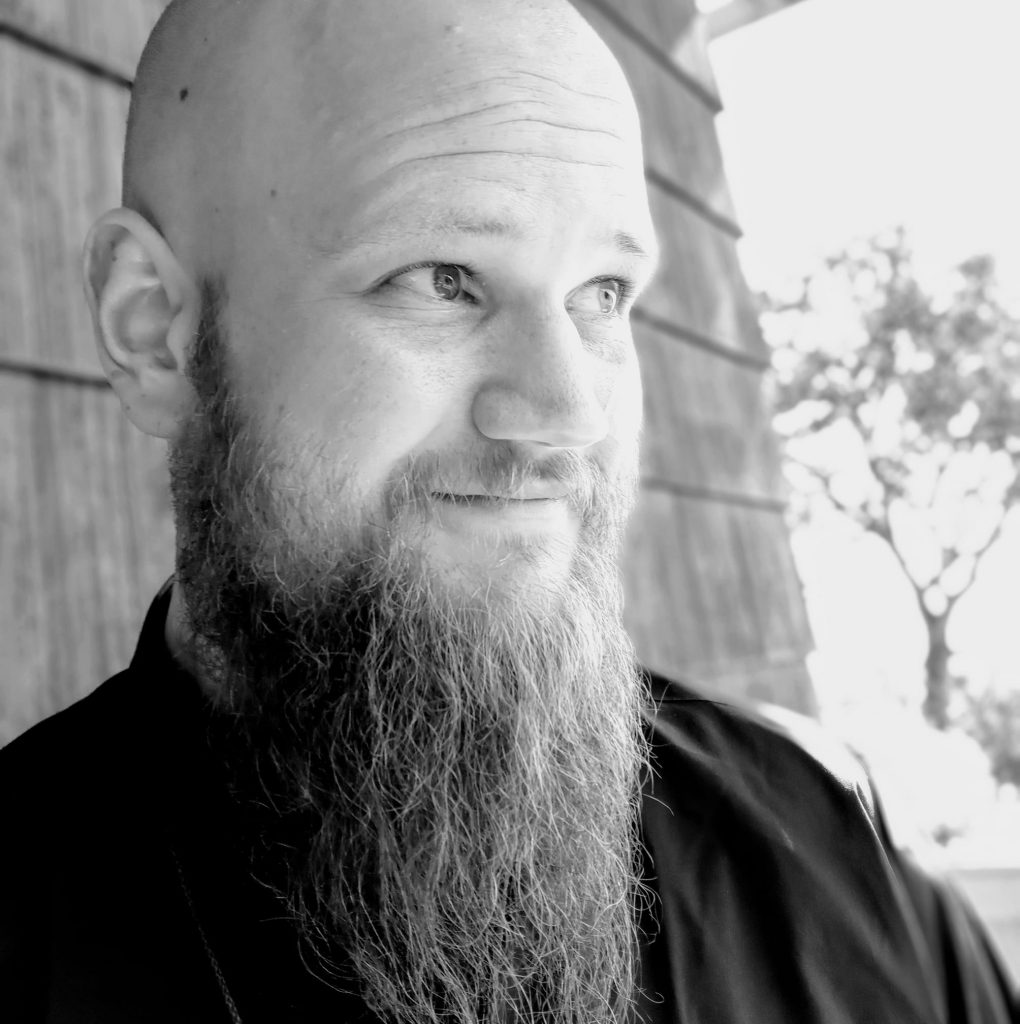
Rev. Thom Muller is pastor at the Swedenborgian Society of the East Bay at Hillside, an Urban Sanctuary, in El Cerrito, CA, as well as senior editor of Our Daily Bread. His passions include the intersection of spirituality and psychology, interfaith theology, and the Western esoteric tradition. A native of Germany, Rev. Muller was ordained into the ministry of the Swedenborgian Church of North America in 2016, upon receiving his theological education at Bryn Athyn College of the New Church and the Center for Swedenborgian Studies and Pacific School of Religion at the Graduate Theological Union in Berkeley.