Ezekiel 1:2-21 (NRSV)
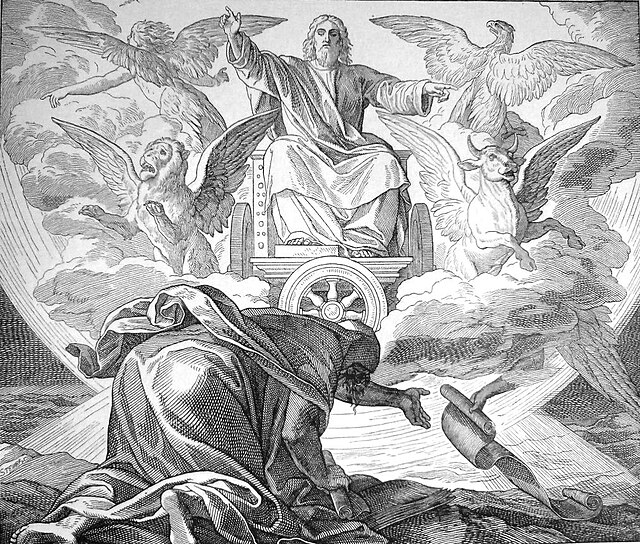
As I looked, a stormy wind came out of the north: a great cloud with brightness around it and fire flashing forth continually and in the middle of the fire something like gleaming amber. In the middle of it was something like four living creatures. This was their appearance: they were of human form. Each had four faces, and each of them had four wings. Their legs were straight, and the soles of their feet were like the sole of a calf’s foot, and they sparkled like burnished bronze. Under their wings on their four sides they had human hands. And the four had their faces and their wings thus: their wings touched one another; each of them moved straight ahead, without turning as they moved. As for the appearance of their faces: the four had the face of a human being, the face of a lion on the right side, the face of an ox on the left side, and the face of an eagle; such were their faces. Their wings were spread out above; each creature had two wings, each of which touched the wing of another, while two covered their bodies. Each moved straight ahead; wherever the spirit would go, they went, without turning as they went. In the middle of the living creatures there was something that looked like burning coals of fire, like torches moving to and fro among the living creatures; the fire was bright, and lightning issued from the fire. The living creatures darted to and fro, like a flash of lightning.
As I looked at the living creatures, I saw a wheel on the earth beside the living creatures, one for each of the four of them. As for the appearance of the wheels and their construction: their appearance was like the gleaming of beryl, and the four had the same form, their construction being something like a wheel within a wheel. When they moved, they moved in any of the four directions without veering as they moved. Their rims were tall and awesome, for the rims of all four were full of eyes all around. When the living creatures moved, the wheels moved beside them, and when the living creatures rose from the earth, the wheels rose. Wherever the spirit would go, they went, and the wheels rose along with them, for a living spirit was in the wheels. When they moved, the others moved; when they stopped, the others stopped; and when they rose from the earth, the wheels rose along with them, for a living spirit was in the wheels. (1)
Keep in mind: Historians report that psychedelic hallucinogens occurring naturally in certain vegetative material were in use by the time Ezekiel saw his vision. Can you imagine sauntering in Ezekiel’s sandals that day? You’re perhaps feeling unsettled, disoriented, afraid, even lost after the collapse of your religious culture, and you wander along the banks of the river Kebar mulling it all over. And the hand of God comes upon your shoulder with a great voice suggests that you get ready to see something. And indeed, you behold a great cloud fast approaching out of which lightning is flashing. As it comes closer you see four living creatures supporting a great arch on top of which God is enthroned. The four living creatures each have four wings and four faces—an ox face, an eagle face, a lion face, and a human face. And alongside each four-faced creature there is a wheel, which upon closer inspection is actually wheels intersecting wheels, and the wheels are shining like chrysolite and are rimmed with seeing eyes.
Shortly before, Ezekiel and his compatriots had been forcibly exported from Palestine up to Chaldea in ancient Babylon, which is modern day Iraq. “There we sat down and wept” they wrote later. It seemed to them that all their hopes of survival as a nation had come to an end. They called themselves God’s chosen people, yet they had been forced to leave God behind, or so they thought, because let us keep in mind that at that time, just like everywhere else in the world, their idea of God was a tribal God, really—a local deity: Yahweh, who hovered in the high parts above the ark of the covenant in the temple in Jerusalem. But now Jerusalem was sacked and that ark was stolen and that temple about to be destroyed. Yahweh presumably was 500 miles away—a homeless deity probably prowling Palestine at that very moment seeking another people who would be more faithful.
It’s in this context that Ezekiel’s vision begins to make sense. This was during the same period of history that monotheism was first grasped—with Isaiah and Jeremiah along with Ezekiel came through as important an insight for religion as the invention of the wheel, if you don’t mind my saying so. And here these two great religious insights (monotheism and God’s whereabouts) are interconnected, because Ezekiel sees that God is NOT tethered to the old temple. On that chariot throne, Yahweh and the heavenly helpers can haul! God has wheels, baby! And this was the vision that helped the people of Yahweh begin to grasp that God gets around and is in fact omnipresent.
This is such an important insight: that God meets us wherever we are. We can be grappling with one of our great life decisions or merely with one of myriad moments each week in which our soul is engaged to respond to life situations, and God is right there with us—is wheeling right along us with wherever we go: into the supermarket, into the conversation with the friend we come across, into the argument we have with some loved one, into all our feelings about ourselves during the course of a day in the totality
of our living: God’s moving right along with us.
God’s rod has wheels within wheels for hairpin, razor-sharp turning—this buggy effortlessly handles the wildest turns and craziest paths our living takes. But wait, there’s more! The Godrod wheels possess a particularly attention-grabbing feature: they’re rimmed with eyes. They see where we’re going before we do! Talk about the latest navigational software: this chariot doesn’t just tail with flawless aplomb, but actually always arrives there before we do—even though we get there of our own accord, making our decisions in freedom.
Yeah, Swedenborg says this whole vision piece of the Godrod is about divine providence: the correspondence of the eyes encircling the wheels is God’s faithful foresight. We’re marveling these days with how we can program smart cars to parallel park for us. Still a far cry from knowing in advance where we’re going. But God knows where we’re going before we choose it, and is already there even though we choose in our freedom and not from pre-programming.
Good theology is lovely with sweet paradox. How much would you give to have such a Godrod available to you? Well hold on, because there’s more! These wheels within wheels rimmed with eyes also come fully equipped with living creatures that have four wings and four faces. Okay, now we’re into some very radical kind of engineering. Because there’s this power system in the wheels connected with these four living creatures, and what do the design specs say there in Ezekiel 1: 21? “The spirit of the living creatures is in the wheels.” Whoa, talk about a
technology bump! The wheels are alive.
If we looked ahead to chapter ten we would read that Ezekiel identifies the four living creatures as cherubim, and cherubim always have one role in scripture: they protect and guide. They are part of God’s providential care system. What do we know about their rules of engagement? We know they each have four wings and four faces. The wings surely indicate aerodynamic capabilities and probably work with the wheels’ differential transaxle system in such a way that this providential care system can go as high as we can ever need or as low as is sometimes needed.
But what about their four faces—eagle, lion, ox, and human: why do they have these faces? Because that is how God can be present with us. Let’s see how this works. Almost always, when we’re struggling, when we’re beset by fears and anxieties or anger by despair, by spiritual definition we have lost our vision, at least for the moment. We already have or are in danger of losing our perspective. What’s that saying?
Perspective alters perception. Christians in ancient Rome, unlike others sent to their theatrical deaths in the Coliseum, went singing, because they had a different perspective on what was going down than did the others. There is always a divine outreach to our spiritual mind for keen discernment and for lofty thinking. When soaring high on strong pinions, our minds gather in a broader vision that can hold our experiences in a spiritual perspective, which helps us understand divine goals for living, which often do not closely resemble earthly goals. There is a divine outreach to us every moment we are alive to rise higher in our thoughts, to enter into the purer atmosphere of heaven’s light, to see ourselves more truly as we are with an uncompromising spiritual integrity, and to see the nature of the life in which we find ourselves. And so these wheels have the face of an eagle.
A second cornerstone of regeneration is courage. We need moral bravery not only to face the demons from without but also those from within. It isn’t always easy, this business of spiritual growth. It isn’t all expensive vision quests in faraway lands or listening to the soothing sounds of Ravi Shankar. More than seldom a learning curve means some pain, means facing a change we’ve been resisting, means deserting a favored place, means renouncing something we’ve loved. It is sometimes about courage, so these wheels have the face of a lion.
And yet it is equally true that the great bulk of our regeneration journey with God is not filled with dramatics, but with daily faithfulness–with doing our daily rounds in quiet confidence and fidelity. Think of the Eucharist: a humble chunk of bread, a small sip of the juice of the vine—deceptive, really, because these are so good, so beautiful. Our grounding routine obligations, these daily uses that can hold so much goodness in them: this is the regimen that God has designed for our long living. Patient labor, trusting what the day can give us, staying the course: do we see how profoundly this daily faithfulness in small things builds our bones, and how much the world needs souls who patiently bear the perennial burdens of creating human community. That’s why these wheels have the face of an ox. And it is always time to reach for what the human potential movement liked to call our higher self! To boldly imagine our full personhood, that angelhood for which we were created, that me and you created in the very image and likeness of God. To believe in the vision that God has for us, something more than we have yet attained, that higher capacity of wisdom and love modeled for us by God personally as the Divine Human: a vision of us extraordinary in letting higher love and wisdom shines through our special and unique personhood. And that’s why these wheels have the face of a human.
It is through our vision of spiritual truth, through our courage, through our steady work, and through our desire to become fully human that we open ourselves to God’s presence, which is always with us. I like to call it heaven on wheels: where we develop our character, our values, our humanity. Heaven always here, moving around wherever we go, and open to us in our sincerity and integrity of effort. Now two and a half millennia later, it’s uncanny how Ezekiel’s dazzling vision of heaven on wheels anticipates how madly future humans will fall in love with wheels. So be it: let’s all hop in and go for a joy ride!
(1) New Revised Standard Version, Updated Edition. Copyright © 2021 National Council of Churches of Christ in the United States of America. Used by permission. All rights reserved worldwide.
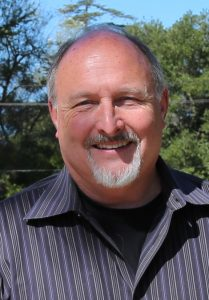
Rev. Dr. Jim Lawrence has been an ordained minister in the Swedenborgian Church of North America for several decades, and has served in a variety of settings and ministries. He currently serves as president of the denomination, after many years as dean of the Center for Swedenborgian Studies at the Graduate Theological Union in Berkeley, CA. Jim lives in Oakland with his wife and dog.